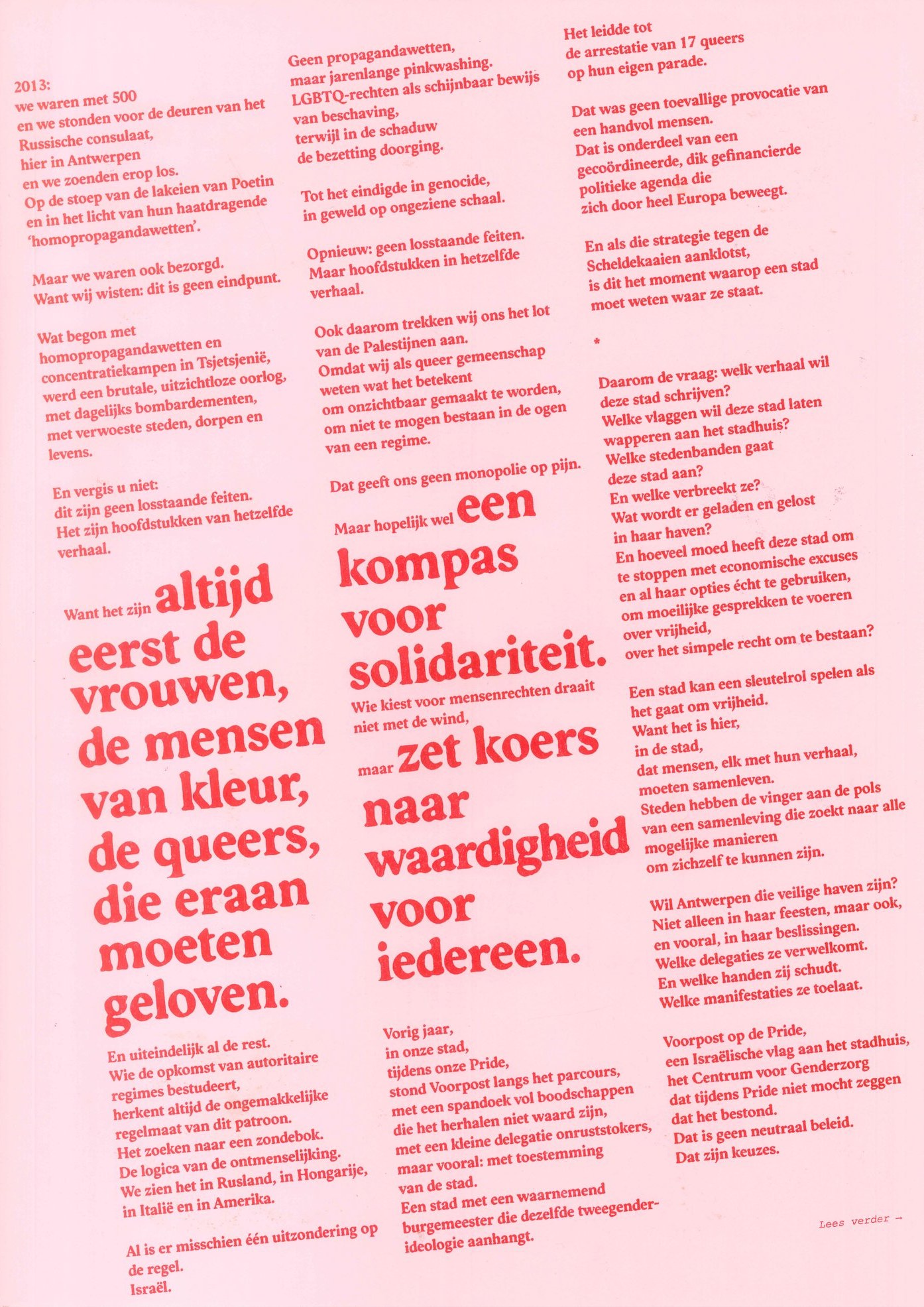
2013: there were 500 of us and we stood at the doors of the Russian consulate, here in Antwerp, and we kissed away. On the doorstep of Putin’s lackeys and in the light of their hateful ‘gay propaganda laws’.
But we were worried too. Because we knew: this is not the end. What began with gay propaganda laws and concentration camps in Chechnya became a brutal, hopeless war, with daily bombardments, with ruined cities, villages and lives.
And make no mistake: these are not isolated facts. They are chapters of the same story.
Because it is always the women, the people of colour, the queers who are the first to pay the price.
And in the end everyone else. Anyone who studies the rise of authoritarian regimes always recognises the uncomfortable regularity of this pattern. The search for a scapegoat. The logic of dehumanisation. We see it in Russia, in Hungary, in Italy and in America.
Though there may be one exception to the rule. Israel.
No propaganda laws, but years of pinkwashing. LGBTQ rights as apparent proof of civilisation, while in the shadows the occupation went on.
Until it ended in genocide, in violence on an unprecedented scale.
Again: not isolated facts. But chapters in the same story.
That is also why we care about the fate of the Palestinians. Because as a queer community we know what it means to be made invisible, to not be allowed to exist in the eyes of a regime.
That gives us no monopoly on pain.
But hopefully it does give us a compass for solidarity. Whoever chooses human rights does not turn with the wind, but sets a course towards dignity for everyone.
Last year, in our city, during our Pride, Voorpost stood along the route, with a banner full of messages not worth repeating, with a small delegation of troublemakers, but above all: with the permission of the city. A city with an acting mayor who subscribes to the same two-gender ideology.
It led to the arrest of 17 queers at their own parade.
That was no chance provocation by a handful of people. It is part of a coordinated, well-funded political agenda that is moving across the whole of Europe.
And when that strategy laps against the quays of the Scheldt, this is the moment when a city has to know where it stands.
Hence the question: what story does this city want to write? Which flags does this city want to fly at the city hall? Which twinnings does this city enter into? And which does it break off? What is loaded and unloaded in its port? And how much courage does this city have to stop making economic excuses and to really use all its options, to have difficult conversations about freedom, about the simple right to exist?
A city can play a key role when it comes to freedom. Because it is here, in the city, that people, each with their own story, have to live together. Cities have their finger on the pulse of a society that is searching for every possible way to be itself.
Does Antwerp want to be that safe harbour? Not only in its celebrations, but also, and above all, in its decisions. Which delegations it welcomes. And whose hands it shakes. Which demonstrations it allows.
Voorpost at Pride, an Israeli flag at the city hall, the Centrum voor Genderzorg that was not allowed to say during Pride that it existed. That is not neutral policy. Those are choices.
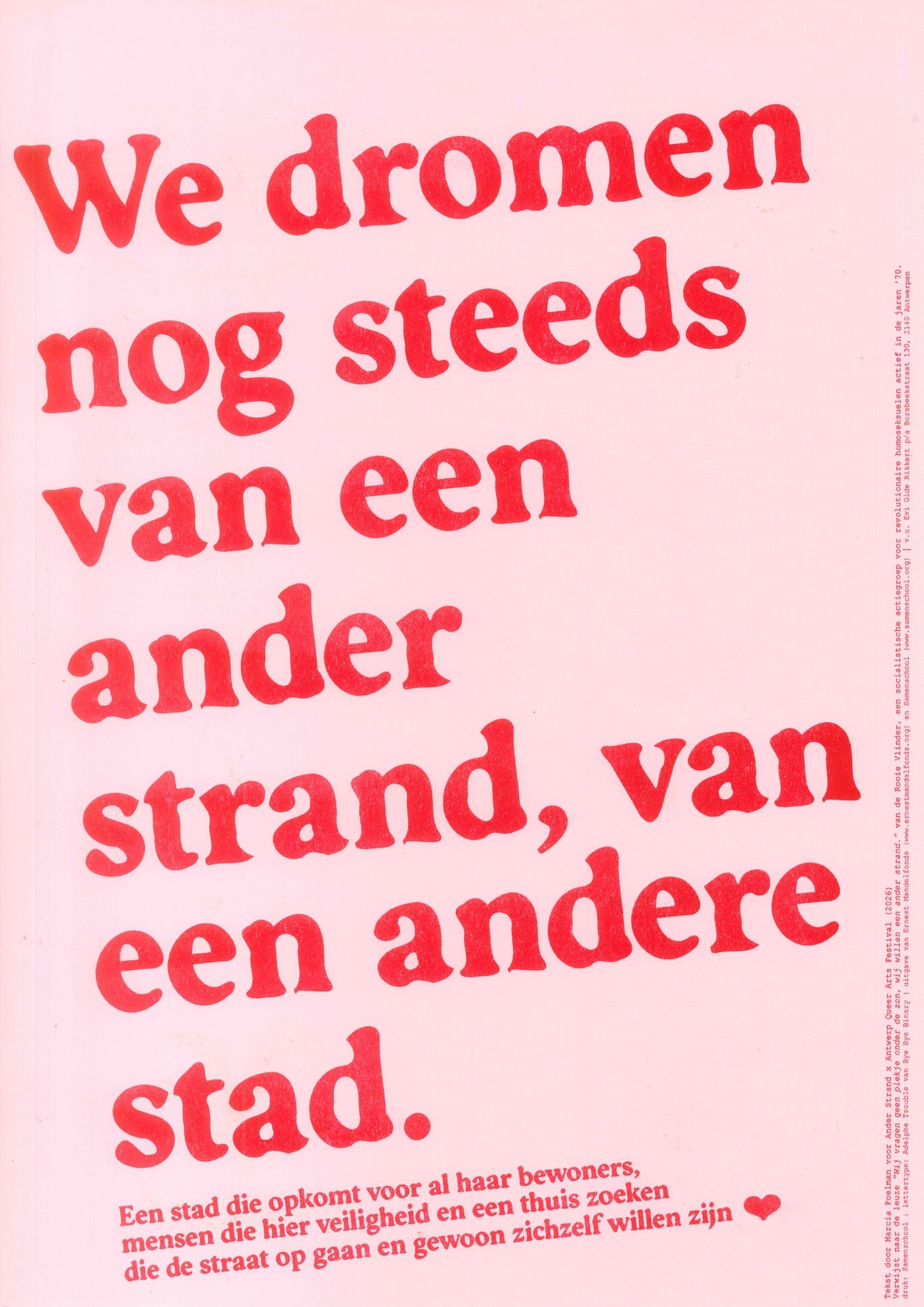
We still dream of another beach, of another city.*
A city that stands up for all its residents, people who come here looking for safety and a home, who take to the streets and simply want to be themselves ♥
* Refers to the slogan of the Rooie Vlinder (the socialist gay liberation group that organised the first Belgian Pride in Ghent in 1978): 'We are not asking for a little place in the sun, we want another beach.' They did not ask for tolerance within the existing society, but for liberation: a different society.